
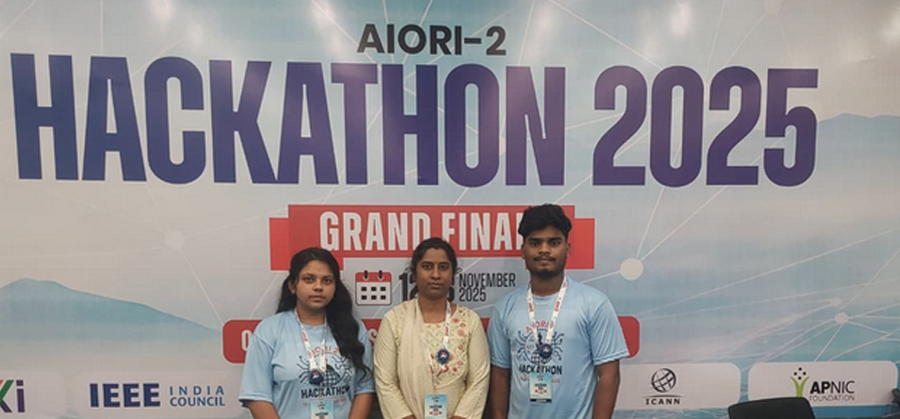
In the high-stakes environment of web operations, “knowing” a site is down isn’t enough—you have to know why and ensure the message gets through the right channel instantly. During the AIORI-2 Hackathon, team SYNOVIA from the Vemana Institute of Technology built the Website Health Monitor with Multichannel Alerts, a Django-based platform that treats RFC compliance as the ultimate benchmark for reliability.
By strictly implementing RFC 7231 (HTTP Semantics) and RFC 5321 (SMTP), the team created a system that eliminates the ambiguity of “false positives” and provides an enterprise-grade observability toolkit.
1. The Engineering of a Health Check
Most monitoring tools simply check if a server responds. Team SYNOVIA went deeper, building a polling engine that interprets the nuances of the HTTP protocol to categorize errors with 100% accuracy.
- Semantic Precision (RFC 7231): The system distinguishes between 4xx (Client Errors) and 5xx (Server Errors), ensuring that a misconfigured URL isn’t reported as a server crash.
- Security Vigilance (RFC 8446/5280): Beyond the application layer, the tool monitors the transport layer, verifying X.509 certificates and alerting administrators 30 days before a TLS certificate expires.
2. Multichannel Alerting: Solving Protocol Latency
One of the project’s most significant findings was the performance gap between communication protocols. To solve this, the team used Celery and Redis to create an asynchronous “fire-and-forget” alerting pipeline.
| Alert Channel | Protocol / Standard | Measured Latency | Operational Insight |
|---|---|---|---|
| SMTP (RFC 5321) | ~800ms | High reliability, but slower due to handshake overhead. | |
| Slack/Webhooks | HTTP POST (REST) | ~300ms | Fast, low-overhead delivery for immediate response. |
| Structured Data | JSON Schema | N/A | Unified payload ensures consistency across all channels. |
3. The Unified Alert Payload
To bridge the gap between legacy email and modern APIs, the team developed a Unified JSON Alert Payload. This schema ensures that whether an alert is sent as an email body or a JSON webhook, the data (timestamps, error codes, service names) remains perfectly consistent.
4. Technical Challenges: The “Double-Alert” Problem
During stress testing, the team encountered a common distributed systems hurdle: concurrent workers sending duplicate alerts for the same failure.
“We solved the ‘alert storm’ by implementing a Redis-based distributed lock. This ensures that only the first worker to detect a ‘DOWN’ state can trigger the notification sequence, keeping the operator’s inbox clean.” — Keerthana C, Team Lead
5. Visualizing Reliability
The system provides a clear, Django-powered administrative dashboard where operators can configure monitoring frequency and view historical uptime data stored in a PostgreSQL backend.
6. Impact and the Path to IETF
Team SYNOVIA isn’t just releasing code; they are contributing to the standard-setting process.
- Internet-Draft: The team plans to formalize their Unified JSON Alert Payload as an informational IETF draft.
- Dataset Sharing: The latency data comparing SMTP vs. HTTP POST will be shared with the AIORI-IMN framework to help other researchers optimize alert delivery.
- Protocol Expansion: Future versions will include monitoring for DNS (RFC 1035) and ICMP (RFC 792) to provide a full-stack view of internet health.