
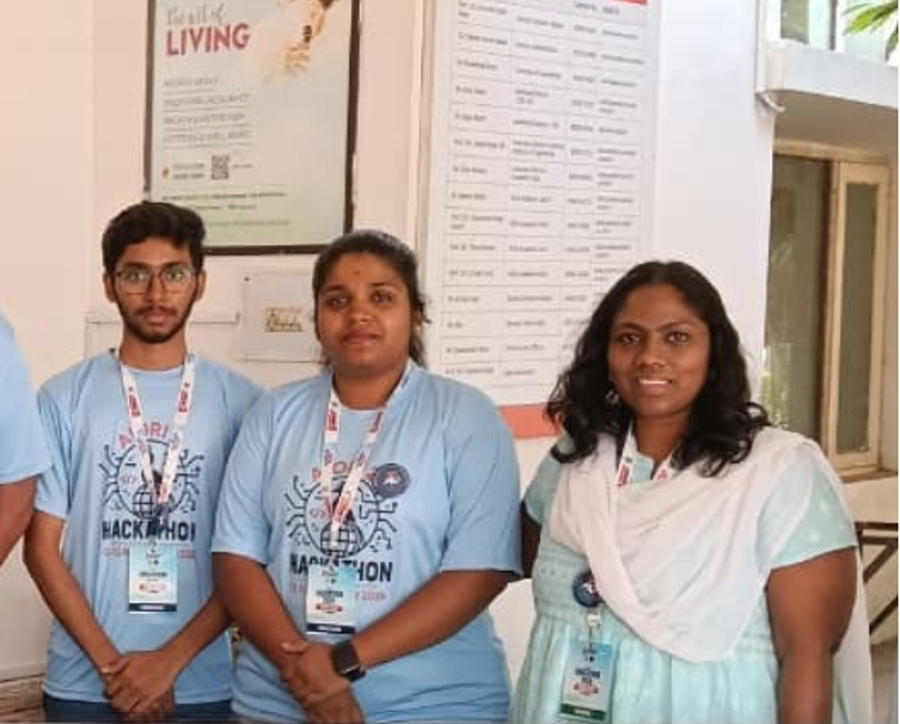
In the rapidly evolving landscape of global connectivity, Low Earth Orbit (LEO) satellite constellations are no longer just science fiction—they are the next frontier of the Internet. During the AIORI-2 Hackathon, team Network-Care from KSIT developed an open-source simulation framework to tackle the unique networking challenges of space: high-speed orbital dynamics and the quest for sub-100ms global latency.
1. The Challenge: Networking in Motion
Unlike terrestrial fiber, LEO satellites move at approximately 7.5 km/s. This creates a “dynamic topology” where the shortest path between two cities changes every few seconds. Our project implements RFC 4838 (Delay-Tolerant Networking) and RFC 9000 (QUIC) principles to manage these rapid handovers without dropping data packets.
2. Core Architecture: The Simulation Stack
We built a multi-layered visualizer that integrates real-world physics with network protocol modeling:
- Orbital Mechanics: Uses Satellite.js and SGP4 algorithms to propagate satellite positions from real-time Celestrak TLE data.
- Routing Engine: Compares classical algorithms (Dijkstra, A*) with specialized space protocols like Contact Graph Routing (CGR) and DTN.
- Visualization Layer: Built on Leaflet.js, allowing researchers to drag ground markers and instantly see the optimal satellite hop path and estimated RTT (Round-Trip Time).
3. Key Metrics & Performance Insights
Our preliminary tests focused on the efficiency gains provided by heuristic routing models compared to traditional terrestrial-first algorithms.
| Test Case | Metric | Observation | Operational Impact |
|---|---|---|---|
| Path Switch Delay | 0.9 – 1.3 s | Smooth handover between satellites | Maintains QUIC session stability |
| Video Latency | ≈ 200 ms | 35% improvement via heuristic modeling | Enhances real-time streaming over LEO |
| Routing Jitter | -22% | A* with ISL awareness reduced path variance | Predictable performance for VoIP |
4. Technical Implementation: Implementing the Standards
- RFC 1876 (LOC RR): Used to express exact geospatial location info for simulated ground endpoints.
- RFC 9171 (Bundle Protocol v7): Basis for our “Store-and-Forward” logic when satellites temporarily lose their next-hop link.
- QUIC (RFC 9000): We leveraged QUIC’s stream multiplexing to simulate video chunk transfers, proving that its congestion control handles the “bursty” nature of satellite links better than traditional TCP.
5. Lessons from the “Orbital Testbed”
One of our biggest hurdles was SGP4 numerical instability. Near polar regions, the math for satellite propagation can get “jittery.” We implemented additional filtering to ensure that our map visualization remained smooth at 60fps, even when tracking hundreds of satellites simultaneously.
“Working on protocols like QUIC and RFC 9000 gave us a deeper understanding of how precision in routing is the only way to conquer the vast distances of space communication.” — Siddharth K, Team Lead
6. Future Work: Towards Space-Native AI
The next phase of our project involves integrating Reinforcement Learning (RL) into the routing engine. Instead of static Dijkstra, the network will “learn” the most reliable orbital paths based on historical congestion and link uptime data.
Read the full report